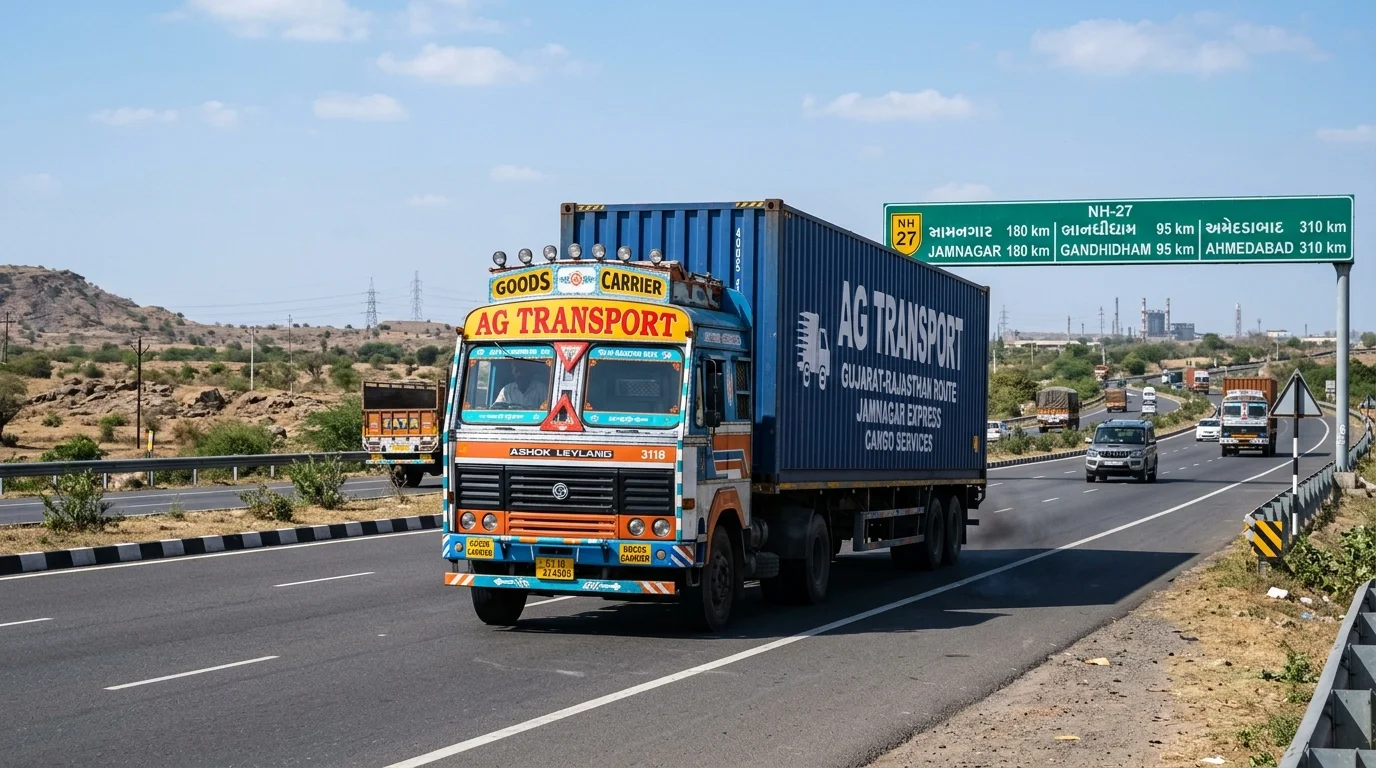
Jaipur to Jamnagar FTL freight transport spans approximately 840 to 880 km, linking Rajasthan industrial hubs with the global refining, petrochemical, and brass manufacturing capital of Saurashtra. Dedicated full-truckload (FTL) dispatches operating with verified dual-driver rotation achieve dock-to-dock transit in 24 to 30 hours via NH-48, NH-62, and NH-27 through Beawar, Sirohi, Palanpur, Radhanpur, Morbi, and Rajkot into Jamnagar. Weatherproof 32-ft multi-axle container trucks safeguard sensitive electricals, finished brass assemblies, and export-grade industrial components, while 10-wheeler to 14-wheeler Taurus trucks handle heavy refractory bricks, structural fabrication, process chemicals, and industrial minerals with zero intermediate cross-docking.
Our junior dispatch supervisor asked me yesterday why our long-haul drivers look so cheerful whenever a manifest lists Jamnagar as the final destination. I told him that our drivers have sharp instincts. They know that once a truck crosses the Gujarat border at Amirgadh, the asphalt turns glassy, the highway dhabas serve piping-hot kathiyawadi sev tameta with bajra rotla, and after eight hundred kilometers of steady diesel hum, the salty sea breeze off the Gulf of Kutch clears any lingering road dust from the air.
I have spent twenty-five years managing freight operations across Rajasthan and Gujarat, and I still inspect tire treads and kingpins like a suspicious father-in-law examining wedding caterers. (My dispatch team insists that is an occupational hazard. I reckon it is the only reason our consignments arrive on schedule.)
When plant managers in the Vishwakarma Industrial Area (VKI) or Sitapura need to move thirty tons of fabricated steel structures, refractory lining, or precision machinery to the mega-refineries in Jamnagar, they cannot afford a single unexpected roadside breakdown. The industrial corridor between Jaipur and Jamnagar is one of western India's most critical supply lifelines, connecting Rajasthan raw materials with Gujarat heavy processing giants. Every hour of delay on this route means honest money slipping down the drain.
The Jaipur-to-Jamnagar Arterial Corridors: NH-62, NH-27, and the Saurashtra Route
When dispatching full truckloads from Jaipur down to Jamnagar, choosing the right arterial route is the difference between a clean twenty-six-hour run and a forty-hour headache. Nine times out of ten, unverified brokers pick routes on consumer map applications that look short on a smartphone screen but funnel heavy multi-axle commercial vehicles through congested city bazaars or poorly graded state highways.
At AG Transport, our fleet operations follow two primary commercial alignments based on payload density, bridge clearances, and delivery windows:
- Primary Alignment (The Northern Saurashtra Corridor via NH-62 and NH-27): Jaipur HQ ➔ Kishangarh ➔ Beawar ➔ Pali ➔ Sirohi ➔ Abu Road ➔ Palanpur ➔ Radhanpur ➔ Samakhiali ➔ Morbi ➔ Dhrol ➔ Jamnagar Industrial Area. Total distance spans approximately 845 km. This is the preferred heavy-freight route for high-cube container trailers and multi-axle Taurus trucks, offering wide four-to-six-lane divided carriageways and bypassing major metropolitan congestion.
- Alternative Alignment (The Central Gujarat Bypass via NH-48 and NH-47): Jaipur HQ ➔ Ajmer ➔ Udaipur ➔ Himatnagar ➔ Ahmedabad Ring Road ➔ Bagodara ➔ Limbdi ➔ Rajkot Bypass ➔ Jamnagar. Total distance spans approximately 880 km. While slightly longer, this alignment connects directly with our Jaipur to Ahmedabad express corridor, serving clients who need consolidated drop-offs or urgent factory dispatches across northern Saurashtra.
Both routes fall under the jurisdiction of the National Highways Authority of India (NHAI), providing sturdy culverts, high overhead bridge clearances, and automated FASTag lanes that keep multi-axle freight rolling smoothly around the clock.
Transit Timelines and Driver Rotation Across 860 Kilometers
Covering 860 kilometers safely in a commercial freight vehicle is not about speeding. It is about steady momentum and scheduled crew discipline. If Roy Scheider in Jaws realized he was going to need a bigger boat, any logistics manager staring at an 860 km haul across the Thar borderlands quickly realizes they are going to need a dual-driver crew.
[Takes a deep breath to simulate a turbocharged six-cylinder diesel engine warming up on a crisp Jaipur morning.]
A single tired driver behind the wheel of a forty-ton rig is a recipe for roadside delays, blown tires, and extended layovers. Under our standard operational protocol, every AG Transport long-haul truck assigned to the Jamnagar corridor operates with a verified two-driver rotation. While one veteran pilot navigates the highway, the relief driver rests in the sleeper berth. The wheels keep turning, stopping only for scheduled refueling, tire temperature checks, and brief meals at trusted transport plazas.
Here is what the honest transit timeline looks like on the ground:
- Dedicated FTL Container (Dual Drivers): 24 to 28 hours dock to dock.
- Heavy Multi-Axle Taurus Truck (Dual Drivers): 26 to 30 hours dock to dock.
- Broker-Sourced Casual Open Truck (Single Driver): 44 to 52 hours, frequently held up by overnight rest stops, local mechanical troubles, and unscheduled roadside negotiations.
When high-value production lines are waiting for spare parts or raw materials, saving eight hours of transit time pays for itself ten times over.
Industrial Cargo Dynamics: Supplying Jamnagar's Refining Giants and Sourcing Brass Components
The trade dynamic between Jaipur and Jamnagar is remarkably balanced, creating dependable two-way freight demand that keeps freight tariffs fair and trucks fully utilized.
On the outbound leg from Jaipur and surrounding Rajasthan industrial hubs like Alwar, Bhiwadi, and Kishangarh, our trucks carry vital supplies for Jamnagar's massive industrial footprint:
- Refining & Petrochemical Consumables: Jamnagar hosts the world's largest grassroots petroleum refining complex as well as major downstream petrochemical installations. Rajasthan manufacturers supply specialized industrial valves, electrical transformers, heavy fabrication assemblies, and process piping governed by heavy machinery transport protocols.
- Refractory Bricks & Mineral Powders: High-temperature kilns and refinery boilers consume thousands of tons of refractory materials, silica, bentonite, and processed mineral powders sourced from Rajasthan mines.
- Paints, Solvents & Industrial Resins: Packaged in drums and IBC totes, these chemical consignments require sealed, spill-contained vehicles with careful axle weight distribution.
On the return leg from Jamnagar back to Jaipur, the cargo profile shifts into precision manufacturing. Jamnagar is universally known as the Brass City of India, producing over seventy percent of the nation's brass hardware, electrical pins, sanitary fittings, gas valves, and extrusion rods. These precision components travel directly back to Jaipur's electrical panel makers, architectural hardware manufacturers, and sanitary ware distributors in VKI and Sitapura.
Because finished brass components are heavy yet compact, loading them requires precise weight balancing across truck axles to avoid exceeding legal axle limits while maximizing allowable payload.
Vehicle Selection: Weatherproof 32-Ft Containers vs. Heavy Multi-Axle Taurus Trucks
Matching the right truck to your specific cargo type is the cardinal rule of professional freight management. Putting dense steel ingots into a high-cube container is just as foolish as tossing weather-sensitive electronic panels into an open-body lorry with a leaky canvas cover. Nine times out of ten, cargo damage happens not because the driver was careless, but because someone booked the wrong category of vehicle to save five hundred rupees on freight.
For the Jaipur-to-Jamnagar corridor, our fleet configuration centers on two battle-tested vehicle categories:
- 32-Ft Multi-Axle Closed Containers (MXL): Designed for volumetric, high-value, and weather-sensitive cargo. With a payload capacity between 14 and 18 metric tons and a loading volume of up to 1,900 cubic feet, these sealed units are ideal for automotive parts, precision electrical switches, packed brass components, and machinery spares. Explore technical container dimensions on our dedicated 32-ft multi-axle container truck service page.
- Multi-Axle Heavy Taurus Trucks (10-Wheeler to 14-Wheeler): When the cargo is dense, heavy, and rugged—such as industrial refractory blocks, structural steel channels, casting scrap, or bulk industrial chemicals—our multi-axle Taurus trucks carry payloads from 16 to 25+ metric tons within statutory Ministry of Road Transport and Highways (MoRTH) gross vehicle weight guidelines.
You can verify vehicle axle ratings, gross vehicle weight limits, and permissible payload capacities directly using our interactive Fleet and Axle Load Matcher Tool before finalizing your transport work order.
FASTag Toll Outlays, Gujarat Border Checkpoints, and GST E-Way Bill Validity
Interstate logistics across Rajasthan and Gujarat demands rigorous statutory compliance. Gujarat enforcement squads at commercial border crossings maintain strict electronic surveillance, and any discrepancy between your physical consignment and digital paperwork can lead to hefty penalties under section 129 of the CGST Act.
Here are the vital compliance checkpoints for the Jaipur-to-Jamnagar route:
- GST E-Way Bill Validity: Under Central GST rules, commercial cargo receives one calendar day of validity for every 200 kilometers of mapped transit distance. For an 860 km haul between Jaipur and Jamnagar, your shipment receives 5 calendar days of statutory validity. You can verify your exact dispatch timeline and validity buffer using our GST E-Way Bill Calculator.
- FASTag Electronic Toll Outlay: Commercial vehicles traveling along NH-48, NH-62, and NH-27 cross between 11 and 13 automated FASTag toll plazas operated by NHAI and concessionaires. A one-way transit for a 3-axle to multi-axle commercial truck typically incurs between ₹3,400 and ₹4,200 in electronic toll deductions. You can estimate your toll budget in seconds with our Highway Transit Toll Estimator.
- Gujarat Commercial Border Verification: At the Rajasthan-Gujarat border checkpoints near Amirgadh and Ratanpur, mobile enforcement teams verify active Part-A and Part-B GST E-Way Bills. The vehicle registration number on the portal must match the physical truck hauling the trailer.
- Industrial Corridor Entry Passes: Delivering inside mega-refining zones and specialized SEZ industrial parks around Jamnagar and Vadinar requires verified driver identity documentation, commercial vehicle pollution certificates, and factory safety clearance paperwork. AG Transport drivers carry complete physical and digital compliance dossiers for prompt gate clearances.
Frequently Asked Questions
What is the typical transit time for dedicated FTL freight from Jaipur to Jamnagar?
Under dedicated Full Truckload dispatch with a verified dual-driver rotation, highway transit across the 840 to 880 km corridor takes approximately 24 to 30 hours dock to dock. Single-driver dispatches arranged by casual middlemen typically take 44 to 52 hours due to mandatory highway sleep halts.
Which highway route is recommended for heavy commercial trucks from Jaipur to Jamnagar?
The recommended heavy commercial route follows NH-48 to Kishangarh, connects with NH-62 through Beawar, Pali, and Sirohi to Abu Road, and joins four-lane NH-27 through Palanpur, Radhanpur, Samakhiali, and Morbi into Jamnagar. This alignment provides multi-lane divided carriage, gentle gradients, and bypasses major urban congestion.
How much are the FASTag toll charges for a commercial truck from Jaipur to Jamnagar?
FASTag electronic toll charges for a commercial 3-axle to multi-axle freight truck along this corridor typically range between ₹3,400 and ₹4,200 for a one-way trip, depending on vehicle axle configuration and specific bypass alignments taken.
How many days of GST E-Way Bill validity are granted for a Jaipur-to-Jamnagar consignment?
Under statutory CGST regulations, a road distance of 860 km receives 5 calendar days of validity, calculated at the mandatory benchmark of 200 km per calendar day for non-over-dimensional commercial cargo.
Why are closed 32-ft container trucks preferred for brass components and refinery spares?
Closed 32-ft container trucks protect cargo against highway dust and monsoon rainfall, eliminate transit pilferage with tamper-evident serial-numbered container seals, and prevent intermediate cross-docking damage between Jaipur factories and Jamnagar industrial gates.
What return freight is available from Jamnagar back to Rajasthan?
Return cargo from Jamnagar into Rajasthan primarily includes finished brass hardware and precision turned parts, electrical fittings, industrial extrusion rods, petrochemical derivatives, synthetic polymers, and base oils, ensuring balanced operations and competitive round-trip freight tariffs.
If an unverified transport broker tells you that eight hundred and sixty kilometers of industrial freight from Jaipur to Jamnagar can be trusted to an overloaded open truck with an exhausted single driver and handwritten toll slips, give our 24/7 Jaipur dispatch desk a call before your cargo ends up stranded on a highway shoulder in the Saurashtra sun.