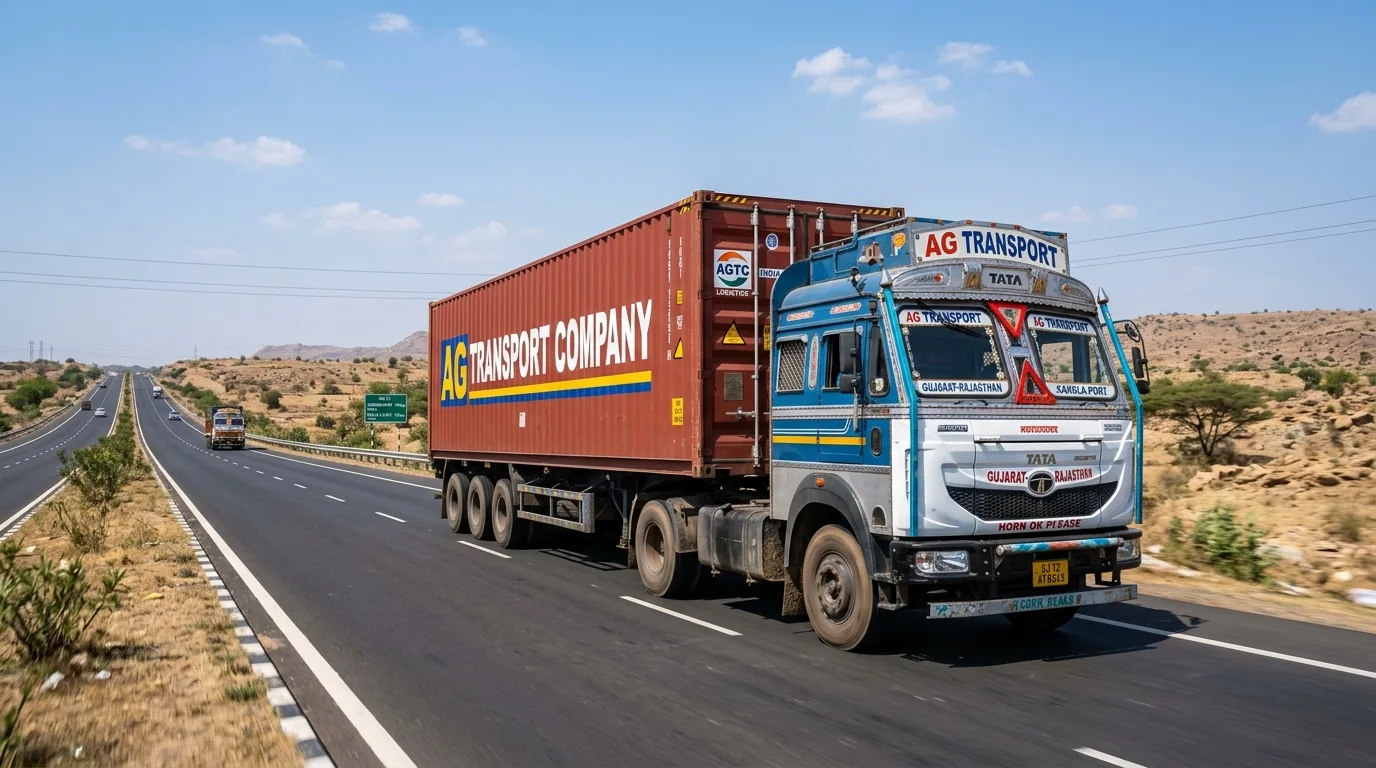
Jaipur to Gandhidham FTL freight transport spans approximately 720 to 760 km, connecting Rajasthan manufacturing centers with the maritime hub of Kutch, Kandla (Deendayal Port), and Mundra. Dedicated full-truckload (FTL) dispatches operating with dual-driver rotation achieve dock-to-dock delivery in 22 to 28 hours via NH-62 and NH-27 through Beawar, Sirohi, Palanpur, Radhanpur, and Samakhiali into Gandhidham. Weatherproof 32-ft multi-axle closed containers protect export-grade textiles, engineering panels, and handicrafts destined for container freight stations (CFS), while 10-wheeler to 14-wheeler Taurus trucks transport processed minerals, feldspar, quartz powder, and Kishangarh marble directly to maritime stuffing terminals and local timber yards.
Our junior dispatch supervisor asked me why our trucks look so eager whenever they get assigned to the Gandhidham run. I told him that trucks have good taste: they know the road to Gujarat is smooth, the highway dhabas serve piping-hot sev tameta with bajra rotla, and after seven hundred kilometers of desert tarmac, even a diesel engine appreciates the scent of sea salt off the Gulf of Kutch.
I have spent twenty-five years managing freight operations across the industrial belts of Rajasthan, and I still scrutinize gross vehicle weight tickets like a forensic accountant reviewing an overdue ledger. (Yes, I know how that sounds to folks who imagine freight logistics is merely tapping buttons on a smartphone app, but when thirty tonnes of export-bound quartz hits an unexpected rumble strip at midnight, software will not keep the drive axle intact.) Transporting high-value industrial cargo from Jaipur manufacturing nodes in Vishwakarma Industrial Area (VKI), Sitapura, or Bagru down to Gandhidham demands honest numbers, vetted tires, and disciplined transit protocols. Hope is a wonderful emotion, but it makes a terrible logistics strategy.
Gandhidham is not just another town in Gujarat; it is the commercial and logistics nerve center of Kutch, sitting right between Deendayal Port at Kandla and the mega-container terminal at Mundra. For Rajasthan landlocked manufacturing economy, this corridor is our primary maritime lifeline. Nine times out of ten, unorganized freight brokers treat this critical port-bound haul like a casual local move, attempting to consolidate partial loads or transferring cargo between intermediate godowns in Palanpur. We operate on a strict zero-cross-docking principle, keeping every consignment sealed from Jaipur loading dock to Gandhidham CFS or factory warehouse via our dedicated Gujarat and Western India freight corridors.
The Jaipur-to-Gandhidham Arterial Corridors: NH-62 & NH-27 vs Western Desert Route
Dispatching commercial freight trucks between Jaipur and Gandhidham involves evaluating two primary interstate highway alignments:
- Corridor A: The East-West Express Arterial (NH-48 to NH-62 to NH-27 via Beawar, Sirohi, Palanpur, Radhanpur, and Samakhiali): Covering roughly 740 kilometers, this route heads southwest from Jaipur along NH-48 to Kishangarh and Beawar, continues down NH-62 past Pali and Sirohi to Abu Road, enters Gujarat at the Maval border post toward Palanpur, and then joins the wide four-lane NH-27 corridor running west through Deesa, Radhanpur, and Samakhiali directly into Gandhidham. This alignment features four-to-six-lane divided carriage, engineered bypasses around urban bottlenecks, and high-capacity fuel plazas, making it the preferred choice for our 32-ft multi-axle container fleet.
- Corridor B: The Western Desert Corridor (NH-48 to NH-25 to NH-68 to NH-27 via Jodhpur, Balotra, Barmer, Sanchore, and Radhanpur): Measuring approximately 770 kilometers, this alignment cuts west through the Marwar heartland past Jodhpur and the industrial clusters of Balotra and Barmer before heading south through Sanchore to join NH-27 at Radhanpur. While this route is invaluable when picking up supplementary cargo such as processed bentonite or petrochemical equipment in Western Rajasthan, it contains longer undivided stretches that slightly increase driving fatigue.
[Takes a deliberate sip of hot kadak chai from an earthen kulhad.]
As Chief Brody famously muttered in Jaws when he saw the ocean predator, you are going to need a bigger boat. In interstate road freight, when an unvetted broker sends a single-axle light truck to pick up twenty-four tonnes of industrial machinery destined for a container ship at Kandla Port, our dispatchers always tell the client: you are going to need a proper multi-axle truck. When your truck leaves the Jaipur factory dock, you deserve the certainty of knowing it has the chassis strength to complete the journey on schedule.
Transit Timelines and Driver Rotation Across 740 Kilometers
Covering seven hundred and forty kilometers across Rajasthan and Gujarat is a swift run when handled by seasoned professionals, but it can quickly unravel if driver scheduling is neglected.
Why did the multi-axle trailer refuse to stop at the desert dhaba? Because it already had a full tank and didn't want any more engine oil puns. Jokes aside, maintaining continuous rolling momentum while respecting highway safety is what separates professional logistics from casual trucking.
- Dedicated FTL with Dual-Driver Relay: 22 to 28 hours dock-to-dock. Two experienced highway drivers alternate driving shifts in four-to-five-hour blocks while the off-duty driver rests in the cabin sleeper berth. The vehicle pauses only for planned fuel refills, automated FASTag plaza sweeps, and scheduled tire temperature checks.
- Single-Driver Dispatch (Unorganized Broker Model): 40 to 48 hours. When budget brokers assign a lone driver to this route, the vehicle must halt for seven to eight hours overnight near Abu Road or Palanpur. That overnight delay can cause missed export gate cut-offs at Kandla or Mundra port container terminals.
- Part-Truckload (PTL) / Hub Consolidation: 4 to 6 days. PTL cargo is unloaded, resorted, and manually handled at intermediate transit godowns, multiplying the hazard of pallet crushing, corner scuffs, and lost documentation.
For export managers facing strict shipping line vessel cut-offs or manufacturing plants awaiting raw materials, dedicated full truckload movement with two drivers is the only dependable option.
Industrial Cargo Dynamics: Supplying Gandhidham, Kandla Port, and Mundra from Rajasthan
The commercial trade link between Jaipur industrial clusters and the Kutch port complex is one of the most active freight ecosystems in western India. Rajasthan provides high-grade industrial minerals and manufactured goods, while Gandhidham serves as the export gateway and import distribution center:
- Processed Industrial Minerals: Massive volumes of pulverized feldspar, quartz powder, soapstone, bentonite, and calcite packed in 25 kg bags and jumbo bags move from grinding units around Jaipur, Kishangarh, and Beawar to Gandhidham container freight stations for maritime export to the Middle East, Europe, and Southeast Asia.
- Polished Marble & Architectural Stone: Finished marble slabs, granite tiles, and sandstone cladding from Kishangarh and Jaipur fabrication docks are transported in secure open-body trucks directly to Gandhidham export warehouses.
- Electrical Equipment and Engineering Goods: Industrial transformers, switchgear panels, and automotive components manufactured in VKIA and Sitapura travel in sealed container trucks to major infrastructure contractors in Gujarat.
- Handicrafts, Textiles, and Garments: Export-grade Jaipur block prints, blue pottery, and home furnishings destined for global retail distribution are delivered directly to marine container stuffing depots.
On the return leg from Gandhidham back to Rajasthan, our fleet loads imported timber including pine and teak logs and sawn lumber from Gandhidham massive sawmill cluster, imported chemicals and soda ash from Kandla Port, refined edible oils, raw salt crystals from Kutch salt pans, and containerized port imports returning to Rajasthan manufacturing units. This robust backhaul traffic keeps empty running to an absolute minimum and enables AG Transport to maintain highly competitive freight rates.
Vehicle Selection: Weatherproof 32-Ft Containers vs. Heavy Taurus Trucks
Assigning the wrong truck configuration to an interstate run is like trying to hammer a railroad spike with a wooden mallet. It looks busy for a minute, but nothing productive gets accomplished. Cargo density, packaging integrity, and weather sensitivity determine the appropriate vehicle selection.
Verify your consignment specifications with our digital Fleet and Axle Load Matcher Tool before booking your truck:
- 32-Ft Multi-Axle (MXL) Closed Container (14 to 18.5 Ton Payload): High cubic capacity (roughly 1,850 to 1,980 cu ft) with all-weather corrugated steel body and heavy lock-rod rear doors. Essential for consumer textiles, electrical transformers, auto parts, and export goods requiring total defense against rain, road dust, and highway theft via our 32-ft multi-axle container services.
- 10-Wheeler / 12-Wheeler Taurus Rigid Truck (16 to 21 Ton Payload): Heavy-duty open trucks with reinforced chassis and dual-layer tarpaulin protection. Ideal for dense industrial freight such as quartz sand jumbo bags, feldspar powder, marble slabs, and imported timber via our Taurus truck freight solutions.
- 14-Wheeler Heavy Multi-Axle Truck (25 to 30 Ton Payload): The workhorse for high-density bulk cargo, moving large mineral shipments, steel coils, and heavy castings within the legal axle thresholds established by the Ministry of Road Transport and Highways (MoRTH).
- Low-Bed and Multi-Axle Trailers (Up to 40+ Ton Capacity): Deployed for heavy machinery, port cranes, and over-dimensional cargo (ODC) requiring special highway permits from the National Highways Authority of India (NHAI) and coordination with RIICO industrial corridors.
FASTag Toll Outlays, Gujarat Border Checkpoints, and GST E-Way Bill Validity
Transporting commercial freight across the Rajasthan-Gujarat border requires strict compliance with statutory commercial tax guidelines and highway toll regulations:
- GST E-Way Bill Statutory Validity: Under Central GST Rule 138, commercial cargo is granted one calendar day of validity for every 200 kilometers of mapped road distance. For a Jaipur-to-Gandhidham haul of roughly 740 kilometers, your consignment receives 4 calendar days of statutory validity. Calculate your transit window and extension buffers with our GST E-Way Bill Calculator.
- FASTag Electronic Toll Outlay: Commercial vehicles traveling along NH-48, NH-62, and NH-27 pass through 9 to 11 automated FASTag toll plazas operated by NHAI and state road authorities. A one-way transit for a 3-axle to multi-axle freight truck incurs between ₹2,800 and ₹3,600 in electronic toll deductions. Forecast your highway toll expenses using our Highway Transit Toll Estimator.
- Gujarat Border & RTO Verification: Commercial tax mobile enforcement teams monitor freight along NH-27 at the Maval and Amirgadh border checkposts. Every vehicle must carry active Part-A and Part-B GST E-Way bills with exact truck registration numbers matching the prime mover.
- Salt-Air Corrosion and Maritime Packaging: Gandhidham and the Kandla coastal belt have high atmospheric salinity and humidity. All open-body consignments carrying mineral powders or metal parts must use heavy waterproof tarpaulins with secure corner wraps to prevent moisture absorption.
Frequently Asked Questions
What is the typical transit time for dedicated FTL freight from Jaipur to Gandhidham?
Under dedicated Full Truckload dispatch with a dual-driver crew, highway transit across the 720 to 760 km corridor takes approximately 22 to 28 hours dock to dock. Single-driver dispatches arranged by casual brokers typically require 40 to 48 hours due to mandatory overnight rest halts.
Which highway route is recommended for commercial trucks traveling between Jaipur and Gandhidham?
The primary commercial truck route follows NH-48 to Kishangarh/Beawar, joins NH-62 through Pali and Sirohi to Abu Road, and connects onto four-lane NH-27 through Palanpur, Deesa, Radhanpur, and Samakhiali into Gandhidham. This alignment offers wide multi-lane divided carriage, smooth bypasses, and reliable commercial fueling stations.
How much are the FASTag toll charges for a commercial truck from Jaipur to Gandhidham?
FASTag electronic toll charges for a commercial 3-axle to multi-axle freight truck along this corridor typically range between ₹2,800 and ₹3,600 for a one-way trip, depending on vehicle axle classification and specific expressway bypass routing.
How many days of GST E-Way Bill validity are granted for a Jaipur-to-Gandhidham consignment?
Under statutory CGST regulations, a road distance of 740 km receives 4 calendar days of validity, calculated at the mandatory benchmark of 200 km per calendar day for non-over-dimensional commercial cargo.
Why are closed 32-ft container trucks preferred for Gandhidham freight?
Closed 32-ft container trucks protect cargo against maritime humidity, prevent dust contamination on export-bound goods, eliminate highway pilferage with tamper-evident container seals, and avoid intermediate cross-docking damage between Jaipur factories and port CFS facilities.
What major industrial clusters in Gandhidham and Kutch are serviced on this freight route?
Direct dispatches from Jaipur service the Gandhidham industrial estate, Kandla Special Economic Zone (KASEZ), Deendayal Port Container Freight Stations, Mundra Port logistics hub, Anjar industrial area, and the Samakhiali manufacturing corridor.
What return freight is available from Gandhidham back to Rajasthan?
Return cargo from Gandhidham into Rajasthan primarily includes imported pine and teak timber from local sawmills, industrial chemicals and soda ash from Kandla Port, refined edible oils, raw salt crystals, and containerized port imports, ensuring economical round-trip freight tariffs.
If an unverified transport broker tells you that seven hundred kilometers of export-bound freight from Jaipur to Gandhidham can be trusted to an overloaded open truck with an exhausted single driver and handwritten toll slips, give our 24/7 Jaipur dispatch desk a call before your cargo misses its container vessel at Kandla Port.