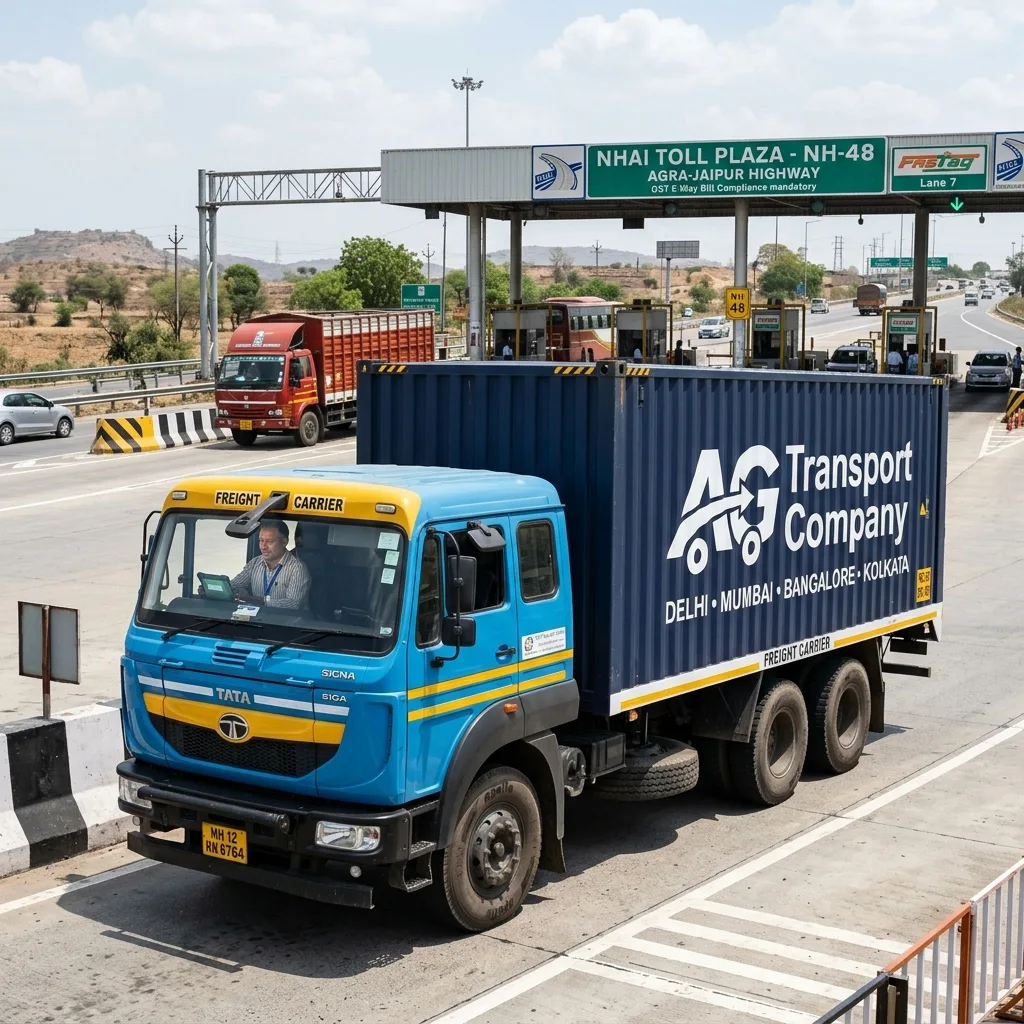
Under CGST Rule 138(10) (Notification 94/2020), GST E-Way Bill validity for standard full truckload (FTL) freight is calculated at 200 km per day (1 day for up to 200 km, +1 day per additional 200 km). For Over-Dimensional Cargo (ODC), validity is calculated at 20 km per day. Extension windows open 8 hours before midnight expiry and close 8 hours after. Use AG Transport's free GST E-Way Bill Validity Calculator for instant calculations.
If I had a rupee for every time a factory manager called our Jaipur dispatch desk asking why their E-Way bill expired while their truck was sitting at a state border weighbridge, I'd be retired on a beach in Goa drinking coconut water. (My wife says I wouldn't last two days on a beach without asking local fishermen about their freight logistics. She's probably right.)
Having supervised full truckload dispatches across Rajasthan for over 25 years, I can tell you that E-Way bill compliance is where half the supply chain headaches in India start and end. You can have a brand-new 32-ft multi-axle container trailer and a veteran driver, but if your E-Way bill expires by 10 minutes near a highway RTO checkpoint, your entire consignment gets locked up faster than a bank vault on a Sunday.
CGST Rule 138(10) Breakdown: 200 KM/Day vs 20 KM/Day Rules
The central motor vehicle and tax guidelines under Central Board of Indirect Taxes and Customs (CBIC) enforce strict daily distance norms for commercial transport:
- Standard Commercial Cargo (200 KM / Day): For standard closed containers, rigid trucks, and multi-axle trailers (e.g. running on our Jaipur to Pune corridor), validity is granted at 1 day for the first 200 km, and 1 additional day for every 200 km or part thereof thereafter.
- Over-Dimensional Cargo / ODC (20 KM / Day): For heavy industrial boilers, transformers, and oversized machinery (such as in our 30-ton boiler transport case study), validity is calculated at 1 day for the first 20 km, and 1 additional day for every 20 km or part thereof.
[Takes a long sip of morning chai to digest CGST notifications.]
Nine times out of ten, unverified brokers assume the old 100 km per day rule still applies. That rule was updated in 2021. If your transport provider is calculating validity using outdated heuristics, your payload is sitting on a regulatory landmine.
Calculating Expiry Deadlines & The 8-Hour Extension Window
Under Explanation 1 to Rule 138(10), "one day" does not mean 24 hours from the exact minute of generation. It means a period ending at 11:59:59 PM (midnight) of the day immediately following the date of generation or Part-B vehicle assignment on the Official E-Way Bill Portal.
When unexpected highway delays happen — whether it's monsoon road washouts, toll plaza queue congestion, or mechanical repairs — CGST rules provide a specific 8-hour extension window:
- Extension Window Opens: Exactly 8 hours BEFORE midnight of the expiry date (4:00 PM on the expiry day).
- Extension Window Closes: Exactly 8 hours AFTER midnight of the expiry date (8:00 AM on the day after expiry).
If you fail to log Part-B vehicle updates or request an extension within that 16-hour window, the E-Way bill status changes to 'Expired' on the national Parivahan network.
Avoiding Section 129 Penalty Traps (200% Tax Payable)
Carrying industrial freight with an expired E-Way bill is an expensive mistake. Under Section 129 of the CGST Act (amended via Finance Act), tax authorities can seize the vehicle and levy a statutory penalty equal to 200% of the tax payable for taxable goods (or 2% of total cargo value / ₹25,000 for exempted goods).
At AG Transport, our 24/7 Jaipur command desk tracks all active dispatches via GPS telemetry. If a trailer gets held up near state borders, our compliance team logs Part-B extensions before the 8-hour window closes.
Using AG Transport's Interactive E-Way Bill Calculator
To help plant managers, dispatch officers, and accounts heads across Rajasthan and India avoid calculation errors, we built a free interactive tool: AG Transport GST E-Way Bill Validity Calculator.
You can select your origin loading hub (Jaipur VKI/Sitapura, Bhiwadi, Kota, Kishangarh), destination industrial estate, fleet quantity, and cargo type to calculate exact midnight expiry dates, 8-hour extension windows, and document checklists in under 10 seconds.
Frequently Asked Questions
How many days of validity do I get for a 600 km FTL shipment from Jaipur to Indore?
For standard FTL cargo covering 600 km, validity is 3 days (200 km/day rule). For ODC cargo, validity is 30 days (20 km/day rule).
Can an E-Way Bill be extended after midnight of the expiry date?
Yes. Proviso to Rule 138(10) allows transporters to extend the E-Way bill up to 8 hours AFTER midnight (until 8:00 AM the following morning).
Who is responsible for updating Part-B of the E-Way Bill when a truck changes?
The transporter or person in charge of the conveyance must update Part-B on the GST portal prior to moving cargo in the new vehicle.
What documents must the truck driver carry during interstate transit?
The driver must carry the 12-digit active E-Way Bill number (or printout), original tax invoice/delivery challan, and AG Transport Lorry Receipt (LR).
If your current logistics partner thinks compliance means crossing your fingers and hoping the RTO inspector is having a nice day, give our 24/7 Jaipur command desk a call. We'll move your freight on honest numbers.